Introduction to Eco Controlled Atmosphere Freshness Storage
A CA (Controlled Atmosphere) storage room is a specialized cold storage facility designed to prolong the freshness of fruits and vegetables by regulating the composition of gases within the storage environment. This is achieved by adjusting levels of oxygen, carbon dioxide, and nitrogen, as well as controlling temperature and humidity. By creating an environment that slows down the natural ripening process, CA storage significantly extends the shelf life of produce.
Atmosphere storage and preservation is a modern preservation technology developed on the basis of traditional refrigeration preservation, and is considered to be a storage method for fruits in the world today
The most effective storage method for fruits. Commercial controlled atmosphere storage has a history of over 80 years in foreign countries, and various products from developed countries, especially apples
The long-term storage of fruits and vegetables such as pears, kiwis, citrus fruits, grapes, and jujubes mostly uses controlled atmosphere storage for preservation. In normal air, it generally contains oxygen
Gas 21%, carbon dioxide 0.03%, the rest is nitrogen and some trace gases. Fruits are living organisms that undergo internal processes before and after harvesting
Metabolic activity dominated by respiration. The characteristics of aerobic respiration after fruit harvesting are: breaking down sugars stored in fruit tissue cells
Carbohydrates such as fruit acids produce carbon dioxide, water vapor, heat, and some aromatic compounds, which consume the fruit body during this process.
The stronger the respiratory function, the faster the consumption, the earlier the ripening period comes, and the shorter the storage time. Oxygen, carbon dioxide, and temperature affect respiratory intensity.
The oxygen content in the storage space is high, the respiratory intensity is high, and vice versa is low. High carbon dioxide gas content in storage space can inhibit respiration and delay
Pectin substances decompose and chlorophyll degrades, and can inhibit microorganisms. The temperature in the storage space decreases, resulting in a decrease in respiratory intensity, and vice versa, an increase.
In addition, a certain concentration of low oxygen and high carbon dioxide in the environment has the effect of inhibiting the growth and expansion of fungal diseases.
The basic principle of controlled atmosphere preservation technology is:
On the basis of sealed storage and refrigeration, air conditioning parameters are set according to the physiological characteristics of different fruits. Through specialized testing and control equipment, the oxygen concentration in the storage space is manually reduced and the carbon dioxide gas concentration is increased to the set air conditioning parameters, and this parameter is accurately maintained throughout the storage period, thereby inhibiting the respiration of fruits and keeping them in a normal and low consumption metabolic state, achieving the purpose of fruit preservation.
Advantages of Modified Atmosphere Storage:
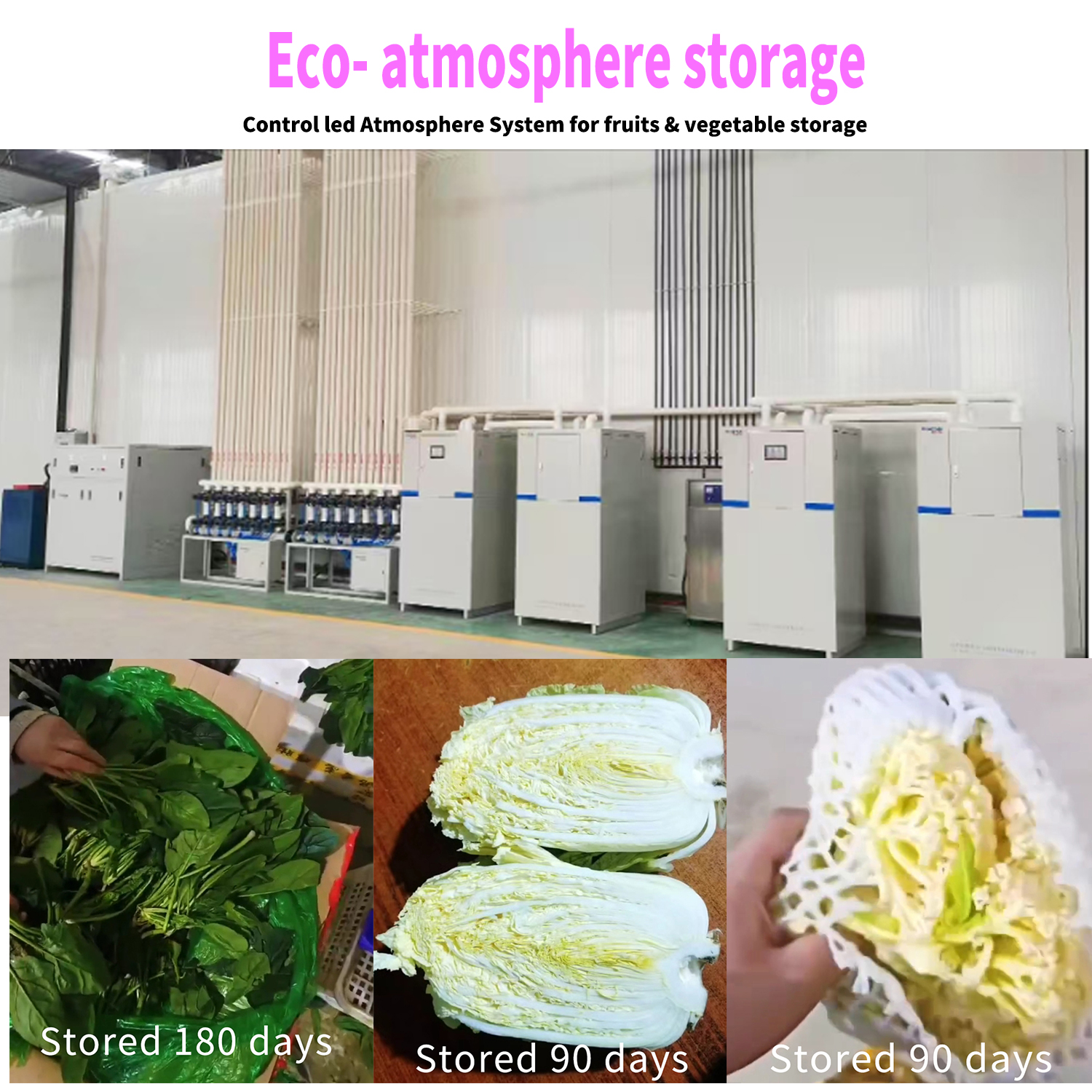
1- The preservation effect is good. After long-term storage, most fruits such as mid to late maturing apples and pears still have bright colors, green stems, pure flavors, and full appearances, which are almost the same as when they were first harvested. Taking apples as an example, after controlled atmosphere storage, the hardness and titratable acidity of the fruit flesh are significantly higher than those of fruits refrigerated at the same time.
2- Long storage time controlled atmosphere storage combines the techniques of low temperature (refrigeration) and regulating the gas composition of the storage environment, greatly inhibiting the respiration of fruits, delaying the rate of fruit metabolism, and extending the storage period of fruits to a large extent.
3-. Low storage loss. Modified atmosphere storage, especially in controlled atmosphere warehouses, strictly controls the temperature, humidity, and gas components such as oxygen and carbon dioxide inside the warehouse, effectively suppressing the respiration, transpiration, and microbial hazards of fruits. During storage, losses caused by water loss, decay, and other factors are greatly reduced.
4- After a long shelf life and controlled atmosphere storage, fruits that have been exposed to low oxygen and high carbon dioxide for a long time still have a long period of "lag effect" after being released from the controlled atmosphere state. According to experiments conducted on apples in Shaanxi, it is generally believed that the shelf life of modified atmosphere storage is 2-3 times longer than that of regular refrigeration, while maintaining the same quality. In addition, under the same storage time conditions, fruits stored under controlled atmosphere have a longer "lifespan" after being released from storage than those stored under refrigeration, making it easier for fruits to be transported and exported over long distances.
Green "storage during fruit controlled atmosphere storage can effectively inhibit the occurrence of infectious diseases due to the interaction of low temperature, low oxygen, and relatively high carbon dioxide. Chemical preservatives are not required during storage.
-------------------------------------------------------------------------------------------------------------------------------------------------------------------------------------------------------------------------------------------------------------------------------------------------------------------------------------------------------------------------------------------------
Composition of Eco Atmosphere Storage
1. Eco Atmosphere Storage room
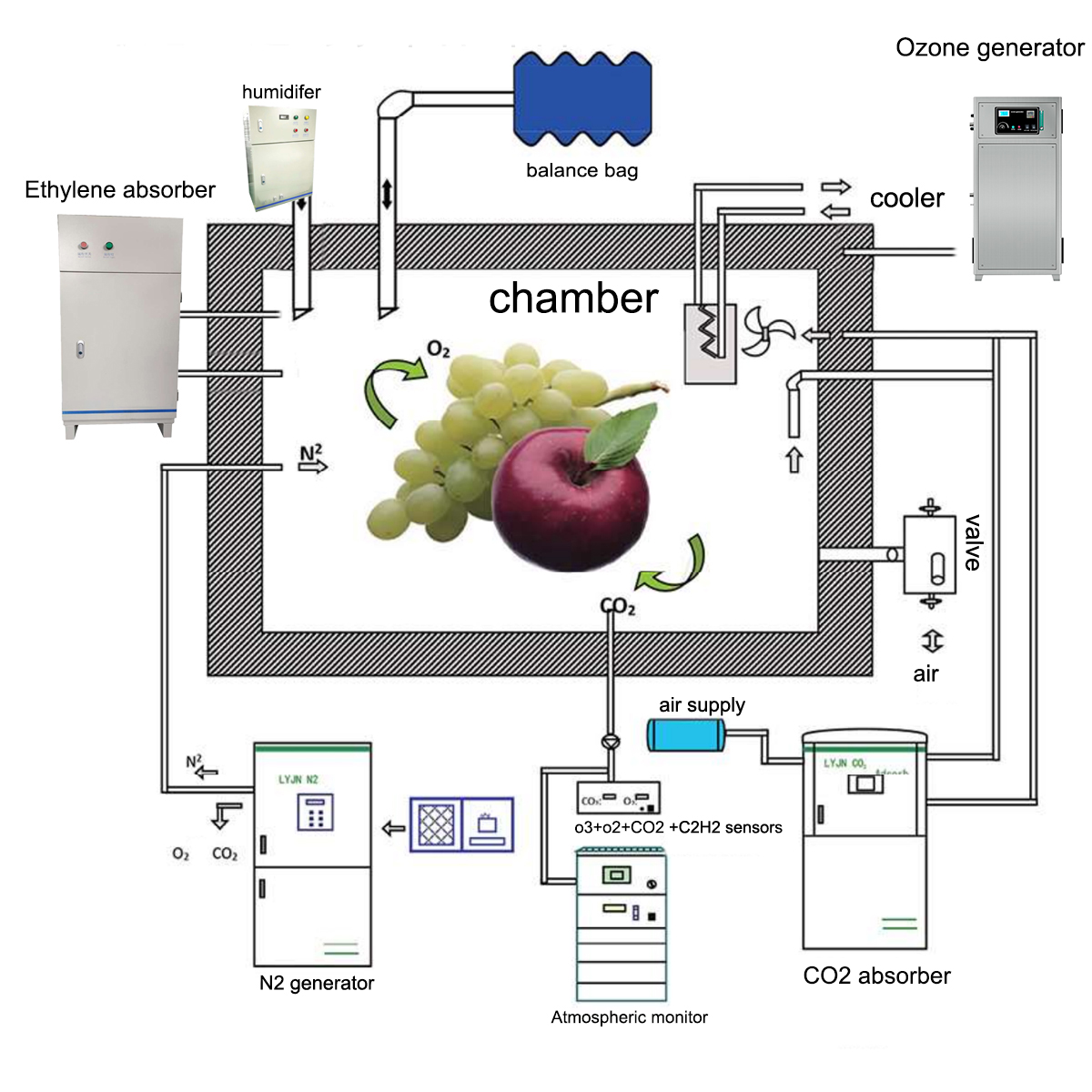
Airtightness is one of the main characteristics that distinguishes the building requirements of air-conditioned warehouses from those of refrigerated warehouses. The controlled atmosphere warehouse requires that the enclosure structure not only has insulation and moisture resistance to reduce heat and cold exchange with the outside world, but also requires strict sealing around the warehouse walls, doors, and all inlet and outlet pipeline connections to minimize gas exchange inside and outside the warehouse. Only in this way can the gas composition inside the warehouse be artificially adjusted to reduce or avoid interference from external gases on the gas composition inside the warehouse. Due to the strict requirements for the airtightness of the enclosure structure in the controlled atmosphere warehouse, during the cooling and air conditioning process, as the temperature and pressure inside the warehouse change, a pressure difference will be generated on both sides of the enclosure structure, which will damage the airtight layer and even cause expansion or collapse of the enclosure structure. In order to balance and reduce the pressure difference inside and outside the warehouse, the controlled atmosphere warehouse must be equipped with safety valves and air conditioning bags, and positive pressure nitrogen filling and oxygen reduction devices should be selected as much as possible.
2 Refrigeration equipment
The modern design of controlled atmosphere storage aims to control temperature fluctuations within ± 0.5 ℃. To achieve this, in addition to requiring the enclosure structure to have a high thermal resistance to reduce external influences, the design of the evaporator in the storage should also adopt a large-area low-temperature difference cold air fan scheme. The design of the entire refrigeration system in a controlled atmosphere warehouse can be based on different situations, using centralized cooling from large units or separate cooling from small units in a single warehouse
Cold, the latter has greater flexibility. In order to ensure the economical operation of the refrigeration unit during the controlled atmosphere process, the insulation layer of the enclosure structure of the controlled atmosphere warehouse should be thicker than that of a typical high-temperature warehouse.
3 Air Conditioning Equipment
(1) Nitrogen generator
The oxygen reduction in controlled atmosphere storage generally adopts the positive pressure inflation replacement method, which means that nitrogen with a higher concentration (nitrogen content>98%) is taken through the nitrogen reduction mechanism and injected into the storage through the pipeline through the oxygen reduction equipment system. At the same time, the gas with a higher oxygen content in the storage is vented through a pipeline. This process is repeated to reduce the oxygen content in the storage to about 3% -5%, and then the oxygen content in the storage is further reduced and the carbon dioxide concentration is increased through the respiration of the fruit itself, in order to achieve the purpose of regulating the gas composition in the storage
(2) CO2 removal machine
During controlled atmosphere storage of fruits and vegetables, the release of carbon dioxide due to respiration will gradually increase the concentration of carbon dioxide in the storage. When the concentration of carbon dioxide reaches a certain value, it will cause carbon dioxide damage and produce a series of adverse symptoms, ultimately leading to decay and deterioration. At this point, it is necessary to use a CO2 removal machine to remove the excess CO2 in the warehouse, achieving the optimal range required by the gas regulation parameters.
(3) Ethylene removal machine
Ethylene is a plant hormone that can promote respiration and accelerate ripening and aging of fruits and vegetables. Some people also call it "ripening hormone". It is a product of the metabolism of fruits themselves. Smoke emitted from chimneys in the external environment, car exhaust, and some factory exhaust also contain a certain amount of ethylene. Fruits that are highly sensitive to ethylene must be equipped with ethylene removal devices to reduce the ethylene concentration under storage conditions to below a threshold.
(4) Automatic control equipment
The controlled atmosphere storage must accurately measure and control the gas composition of each compartment throughout the entire storage period. In order to improve the automation level of the operation and management of the controlled atmosphere storage, domestic and foreign controlled atmosphere equipment manufacturers have designed and manufactured corresponding automatic control equipment, which has achieved automation in most of the above work. A control system can be used to control around 20 air conditioning rooms, each of which can set its own air conditioning parameters according to the variety of fruit and perform automatic patrol detection
(5) Humidifier and ozone generator
Due to the long storage period of fruits in the controlled atmosphere warehouse, the nitrogen gas filled in is also very dry, and the water content of the fruits evaporates more. In order to reduce the storage environment
The partial pressure difference of water vapor between fruits and vegetables inhibits water evaporation, maintains high relative humidity in the controlled atmosphere storage, and reduces the water loss rate and dry consumption of fruits and vegetables-
Generally, sealed ultrasonic humidifiers should be installed in controlled atmosphere warehouses. Ozone disinfection is a safe and environmentally friendly technology that can be controlled in warehouses
The method utilizes the reaction of air inside the reservoir to generate ozone (ionized oxygen) to reduce the disturbance of various pathogenic bacteria and the development of microorganisms, which can reduce
Due to a series of problems caused by long-term cold storage, such as premature aging, decay and deterioration, development of pathogens, dehydration, etc., during storage for a period of time


